Colour Prediction vs Lottery – Format, Payout and Risk Comparison
Two of the most commonly discussed game formats inside Indian gaming apps are colour prediction and lottery — and most users treat them as variations of the same thing. They are not.
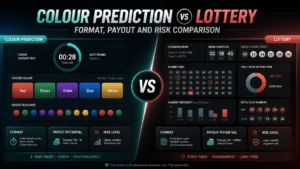
Colour prediction vs lottery is a comparison between two structurally different formats. They use different draw mechanisms, operate on different time cycles, carry different payout structures, attract different legal classifications, and create different risk profiles for users. Understanding these differences clearly is more useful than any “which one is better” verdict — because the honest answer is that neither format guarantees user profitability, and both carry risks that deserve equal attention.
This page explains both formats from the ground up and compares them across every dimension that matters to an Indian user in 2026.
What Is Colour Prediction Format?
Colour prediction is a fast-cycle prediction format built around short countdown timers. In the most common version — WinGo — users choose one of three colour outcomes: Green, Red, or Violet. A timer counts down, typically 60 seconds, and the platform reveals a result generated by a Random Number Generator (RNG).
How payouts work in colour prediction:
- Correct colour prediction (Green or Red) — pays approximately 2x, with the actual payout set at 1.92x to account for the house edge
- Correct Violet prediction — pays at a higher multiplier (typically 4.5x) because Violet appears less frequently by design
- Incorrect prediction — stake is lost entirely
The speed of WinGo-style colour prediction is one of its most defining characteristics. A user can place and resolve a prediction within 60 seconds. At scale — across multiple rounds per hour — this creates a high-frequency wagering environment where the house edge compounds quickly. The colour trading vs lottery game distinction often comes down to this pace difference alone.
What Is Lottery Format?
Online lottery formats — primarily K3 and 5D as found on Indian gaming apps — are draw-based prediction games operating on slightly longer cycles than WinGo. K3 draws typically run every one to three minutes. 5D draws follow similar intervals.
How K3 lottery works:
Three virtual dice are rolled. Users predict the outcome — the sum category (Big or Small), the exact sum, a specific combination, or a triple. Results are RNG-generated.
How 5D lottery works:
Five independent digits between 0 and 9 are drawn. Users predict outcomes across positions — individual digit, sum category, odd/even. More prediction options, more complexity, variable payout ratios.
Unlike colour prediction’s binary or tri-colour structure, lottery formats offer multiple prediction types within a single draw. This creates the appearance of more strategic depth — but because results are RNG-generated, the additional complexity does not change the fundamental mathematical reality that the house edge applies to all prediction types regardless of how they are structured.
Side-by-Side Comparison – colour prediction vs lottery
| Feature | Colour Prediction (WinGo) | Online Lottery (K3 / 5D) |
| Draw Cycle Speed | Every 60 seconds | Every 1–3 minutes |
| Prediction Type | Colour or number outcome | Number sum, combination, or position |
| Result Mechanism | RNG | RNG |
| Standard Payout (common prediction) | 1.92x | 1.92x (Big/Small) — higher for specific predictions |
| House Edge | ~4% on standard predictions | ~4% on Big/Small — varies on specific predictions |
| Prediction Complexity | Low — 3 options in WinGo | Moderate to high — multiple prediction types |
| Rounds Per Hour | Up to 60 | 20–60 depending on draw interval |
| Skill Element | None — purely RNG | None — purely RNG |
| Legal Classification | Game of chance | Game of chance |
| Legal Status in India | Unregulated — grey area | Unregulated — grey area |
| Risk Compounding Speed | High — 60-second cycles | Moderate — slightly slower cycles |
| Typical User Appeal | Fast, simple, accessible | More options, slightly slower pace |
Which Has Better Odds? (colour prediction vs lottery)
This is one of the most searched questions in the colour prediction vs lottery space — and the honest answer is neither.
Both formats are built on the same mathematical foundation: a house edge that ensures the platform retains a percentage of all aggregate wagering over time. The specific numbers look like this:
Colour prediction (WinGo Big/Small or colour):
True probability of a correct prediction on a two-option outcome: 50%. Fair payout at 50% probability: 2x. Actual payout: 1.92x. House edge: approximately 4%.
K3 lottery (Big/Small):
True probability of a correct Big or Small prediction: approximately 50% (with slight adjustment for triple outcomes that fall outside both categories on some platforms). Fair payout: 2x. Actual payout: 1.92x. House edge: approximately 4%.
On the most common prediction types — Big/Small in both formats — the mathematical house edge is essentially identical. Neither format offers meaningfully better odds than the other at the standard prediction level.
Where lottery formats appear to offer better odds is in specific-combination predictions — predicting an exact dice combination in K3 or an exact digit position in 5D does carry higher payout multipliers. But these multipliers are still set below the mathematically fair payout for those probability levels. The house edge is present across every prediction type in both formats — it is simply expressed differently depending on the prediction complexity.
The bottom line: neither colour prediction nor lottery gives users a mathematical edge. Both are designed to be profitable for the platform in aggregate. The colour trading vs lottery game question, when reduced to pure mathematics, does not produce a winner for users.
Legal Classification Differences
This is one area where colour prediction and lottery formats diverge slightly in Indian legal context — though the practical difference for users of APK-based private platforms is minimal.
Colour prediction:
Classified as a game of chance under the Public Gambling Act, 1867. Not covered by any lottery regulation. Not classified as a skill game by Indian courts. Operates in a legal grey area across most states. Prohibited in Tamil Nadu, Telangana, and Andhra Pradesh.
Online lottery (K3 / 5D on private apps):
Also classified as a game of chance. Not covered by the Lotteries (Regulation) Act, 1998 — because that Act applies to state-run lotteries, not private online prediction platforms. Falls under the same Public Gambling Act framework as colour prediction. Also prohibited in Tamil Nadu, Telangana, and Andhra Pradesh.
The key legal distinction that does exist:
State-run lotteries — Kerala lottery, Goa lottery, Sikkim lottery — are genuinely legal where they operate because they are authorised under the Lotteries (Regulation) Act, 1998. Private K3 and 5D apps are not state-run lotteries and are not covered by that Act. Users who conflate private online lottery apps with state-run lotteries are misunderstanding a legally significant difference.
Neither colour prediction nor private online lottery formats are registered under the Online Gaming Act, 2025 in the platforms commonly available to Indian users. Both operate without SRO membership, RBI authorisation, or consumer protection mechanisms.
Risk Profile — Which Is Riskier?
Both formats carry the same structural risks — unregulated platforms, no consumer protection, RNG without independent auditing, and a house edge working against users in the long run. The risk profiles are essentially identical in type. Where they differ is in tempo.
Colour prediction runs faster. A user can place up to 60 bets per hour in a WinGo format. At ₹100 per bet, that is a potential exposure of ₹6,000 per hour at minimum stake. The speed of the format creates conditions where financial exposure can escalate quickly, and where chasing losses is psychologically easier because the next round is always seconds away.
Lottery formats run slightly slower. Fewer rounds per hour means slightly lower financial velocity at the same stake level. This does not make lottery formats safe — it simply means the compounding effect of the house edge operates at a marginally slower pace.
For users who are concerned about problem gaming tendencies, the speed difference between the two formats is the single most practically relevant distinction. A slower format creates slightly more natural pause points than a 60-second colour prediction cycle.
Frequently Asked Questions – Colour prediction vs lottery
Q1. Which is safer — colour prediction or lottery?
Neither format can be described as safe in any regulatory or financial sense. Both are games of chance operated by unregulated, APK-distributed platforms in India. The structural risks — no consumer protection, no audited RNG, house edge working against users — are identical. If speed of play is a concern, lottery formats run slightly slower than 60-second colour prediction cycles, which creates marginally more natural pause points.
Q2. Which format has higher payouts?
On standard Big/Small predictions, both formats pay approximately 1.92x — identical. Lottery formats offer higher payout multipliers on specific combination predictions, but these payouts are still set below the mathematically fair level for those probability outcomes. Higher headline multipliers do not mean better odds — they reflect lower probability, not platform generosity.
Q3. Which format is faster?
Colour prediction — specifically WinGo — runs on 60-second cycles, making it the faster format. K3 and 5D lottery draws typically run every one to three minutes. The speed difference means colour prediction allows significantly more rounds per hour at any given stake level.
Q4. Is colour prediction or lottery legal in India?
Both formats operate in a legal grey area under Indian law as offered by private APK-based platforms. Neither is covered by the Lotteries (Regulation) Act, 1998. Both fall under the Public Gambling Act, 1867 and the Online Gaming Act, 2025 framework. Both are prohibited in Tamil Nadu, Telangana, and Andhra Pradesh. State-run lotteries are a separate legal category entirely.
Q5. Can you switch between colour prediction and lottery on the same app?
Most colour prediction platforms — including Daman Game and 91 Club — offer both WinGo-style colour prediction and K3/5D lottery formats within the same app. Users can switch between formats freely. Both formats carry the same house edge and the same regulatory risks — switching between them does not change the underlying risk profile.
Q6. What responsible gaming advice applies to both formats?
Set a fixed budget before playing any format and do not exceed it regardless of outcomes. Understand that the house edge applies equally to both colour prediction and lottery — neither format gives users a mathematical advantage over time. Avoid chasing losses in either format. If you find the fast cycle of colour prediction or the higher multipliers of lottery formats drawing you into spending more than planned, treat that as a warning sign worth acting on. Help is available through iCare and qualified mental health professionals.
This content is for educational and informational purposes only. We are not affiliated with any platform mentioned on this page. No affiliate links are present. Nothing here constitutes financial, legal, or investment advice.
Related reading — recent guides on this site
- Cricket ID vs Colour Prediction Category — The two categories compared structurally.
- Cricket ID Session Behaviour vs Colour Prediction Sessions — How session behaviour differs between the two categories.
- Cricket ID Bonuses vs Colour Prediction Bonuses — How bonus and wagering structures compare across categories.
