BDG or Daman Game? What Actually Differs Between the Two Apps
Readers of this site often ask how BDG and Daman Game differ, because the two apps look almost identical at first glance. This guide sets out the practical differences a careful adult should check, without naming a winner or inventing figures. It also explains why, in India, the law now prohibits online money games altogether.
Why the Comparison Needs Care
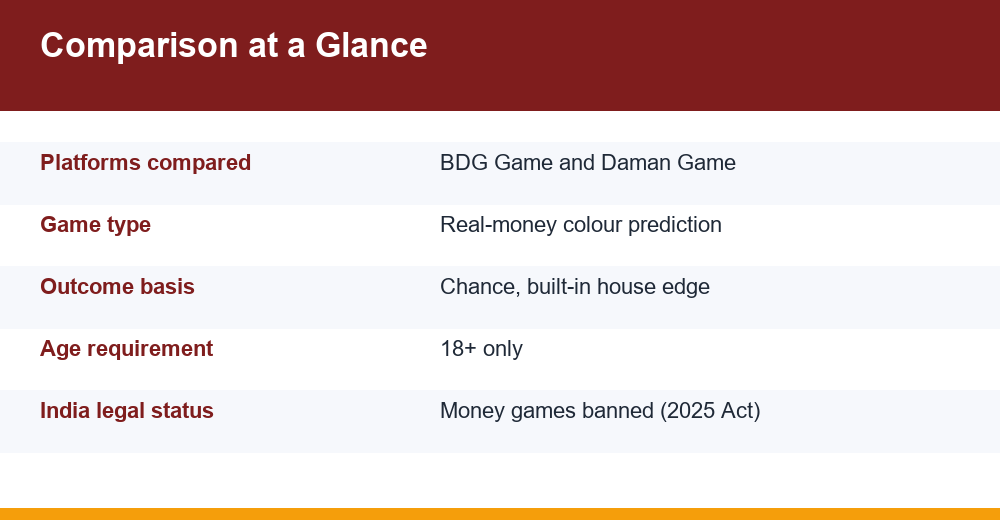
BDG, which promoters sometimes call Big Daddy Game, and Daman Game both belong to the same family of real-money colour-prediction apps aimed at users in India. You pick a colour, a number or a size, a timer runs out, and a result is declared. Money staked on the wrong outcome is lost.
Because these apps share a similar layout, wallet screen and game list, people tend to assume they are interchangeable. A fair review has to look past the colour scheme and ask how each operator handles your money, your identity documents and its own rules.
A few facts apply to both before any comparison begins. Real money is at risk on every round. Outcomes are decided by chance, and the payout structure carries a house edge, which means the expected value of play is negative over time. Both are strictly for adults aged 18 and over.
If you want to see how one information site describes the first platform, its bdg game page summarises the menus and login flow. Treat any such site as one source among several, not as an independent audit, and check what it says against the app’s own terms.
We have no access to either operator’s internal data, so this article quotes no user numbers or win rates. Nothing here is an invitation to sign up, deposit or play.
Game Formats and Round Speed
Both apps lead with a Win Go-style colour round, where outcomes are grouped as colours (commonly red, green and violet), numbers 0 to 9, and big or small. Around that core, each platform adds its own mix of lottery-style, dice-style and casino-style titles. A long menu is not a sign of quality; it simply widens the ways to lose money quickly.
Menus also change without notice, so base any comparison on what the current app shows rather than on old videos or forum posts. For a closer look at how round types are structured, see our analysis of Daman Game round formats; the same checklist works for the other app.
- Is there a written rules page for every game, not only the main colour round?
- Are payout multipliers shown in plain figures before you stake?
- Does the rules page explain how a result is generated, or only how to bet?
Timers matter more than most users realise. These apps typically offer rounds lasting one, three, five or ten minutes. A shorter timer means more decisions per hour, and with a negative expected value, more rounds means more expected loss. As an illustrative example only: staking ₹100 on each of 60 one-minute rounds puts ₹6,000 into play in an hour, and even a small house edge across that volume adds up.
Fast rounds also make it easy to chase losses by raising stakes to win back what has gone. Chasing does not change the odds of the next round; it only increases the amount exposed. Note whether either app offers session reminders, cool-off timers or deposit limits, because their absence is a meaningful difference in itself.
Deposits and Withdrawals
This is where users most often report problems with apps in this category. Deposits are usually instant; withdrawals are where rules, minimums and delays appear. Read the withdrawal terms first, looking for minimum amounts, daily caps, turnover conditions, processing times and fees. Our comparison of Daman Game withdrawals with peer apps explains these terms in more detail.
| Factor | What to check on both apps |
|---|---|
| Deposit methods | Which payment routes are listed, who the payee is, and whether payee names change between deposits |
| Turnover rules | Must deposits be staked a set number of times before withdrawal? |
| Minimum withdrawal | Is it stated clearly in the terms? |
| Processing time | Is a time window written in the terms? |
| Failed or pending payouts | Is there a documented complaint route? |
A warning sign on either app is a payee name that does not match the brand, or a request to pay an extra fee or tax before a withdrawal is released. And because India’s 2025 Act prohibits facilitating payments for online money games, banks may block or reverse such transactions, which can leave balances stuck with no clear route to recover them.
A simple record-keeping habit makes any comparison more reliable. Before money moves on either app, take dated screenshots of the withdrawal and turnover terms, note the payee name shown on each payment screen, and keep every UPI or bank transaction reference. If the terms later change, or a payout stays pending, you will have evidence to show your bank or to attach to a complaint, rather than relying on memory or on a support agent’s word.
KYC Checks and Referral Terms
Both apps may ask for a mobile number, bank details and sometimes identity documents. Compare what each one asks for and why, and look for a privacy policy that names a company, an address and how long your data will be kept. Be cautious about uploading Aadhaar, PAN or bank documents to an operator that is not clearly identified, and never share OTPs, UPI PINs or passwords with anyone claiming to be support staff.
Before sharing any personal details, run through a short checklist on each app:
- Does the privacy policy name the company that will hold your data?
- Does it say whether data is shared with agents, partners or payment intermediaries?
- Is there a written way to request deletion of your account and documents?
- Are support contacts on an official page, not only in chat groups?
Colour-prediction apps also run referral or agent schemes that pay commission when people you invite deposit or play. Focus on whether the rules are written down and whether commission can be withdrawn under the same conditions as other balances. Under India’s 2025 Act, promoting online money games is itself prohibited, which adds legal risk to joining such schemes.
Transparency and Red Flags
There is no public evidence that allows us to call either platform a scam, and we do not do so. But there are clear signals of how open an operator is. The most useful single question is: who runs this app, and where can you hold them to account? Many apps in this niche list no registered company, no physical address and no regulator.
| Check | Reassuring sign | Red flag |
|---|---|---|
| Operator identity | Named company with address | No company name anywhere |
| Terms and conditions | Complete, dated, consistent | Missing, vague or changing often |
| Result generation | Method explained in rules | No explanation at all |
| Support | Written ticket trail | Only chat groups or agents |
| Promotion | No profit promises | ‘Guaranteed wins’, ‘prediction hacks’ |
Any Telegram group or paid ‘signal’ claiming to predict colour results is a red flag; results are chance-based, and no pattern-reading method changes the house edge. Be equally wary of gift codes and login pages shared by strangers, because copycat websites can imitate a familiar brand to collect passwords or payments.
As an illustrative example of how to use the table: suppose one app shows a dated terms page and a support ticket number for every query, while the other answers only through an agent on a messaging app. That gap does not make the first app safe or lawful, but it does tell you which operator leaves a written trail if something goes wrong. Score both apps against each row before drawing any conclusion.
The Legal Position in India in 2026
India’s Promotion and Regulation of Online Gaming Act, 2025 received Presidential assent in August 2025. It separates e-sports and online social games, which it allows and supports, from online money games, which it prohibits. Offering, advertising and facilitating payments for online money games are all banned, with penalties for operators and promoters that include imprisonment and fines.
The Ministry of Electronics and Information Technology notified the Promotion and Regulation of Online Gaming Rules, 2026 in April 2026, and they came into force on 1 May 2026. They set up the Online Gaming Authority of India to classify games, maintain lists of prohibited money games and handle complaints. Real-money colour prediction appears to fall squarely within the Act’s definition of an online money game, which applies equally to both platforms.
This section is a general summary for information only and is not legal advice. If you have a specific legal question, consult a qualified lawyer.
The Bottom Line
A careful comparison of these two apps does not end with a winner. Both are real-money colour-prediction platforms built on chance, both carry a house edge, and in India both sit within a category of games that the 2025 Act prohibits. The real differences lie in how clearly each one explains its rules, withdrawals and data handling, and how openly the operator identifies itself.
- Read withdrawal and turnover terms before anything else.
- Identify the operator and look for a working complaint route.
- Do not upload identity documents to an unidentified operator.
- Ignore prediction tools, paid signals and ‘earning’ claims.
- Remember that 18+ applies and that Indian law prohibits online money games.
If you are already using either app, the most protective step is to stop adding money, withdraw what you can under the written terms, and keep your records. Telling a trusted friend or family member what you have spent can also make it easier to step back.
If you believe you have been defrauded, report it at cybercrime.gov.in or call the national cyber fraud helpline 1930. If gaming is affecting your mood, sleep, finances or relationships, the free Tele-MANAS mental-health helpline is available on 14416.
Frequently Asked Questions
Is one of these apps safe and the other unsafe?
No. Both are real-money colour-prediction platforms where outcomes are chance-based and the house keeps an edge. Neither is independently audited in public, and in India both fall within online money games, which the 2025 Act prohibits. The useful comparison is about terms and transparency, not safety.
Can any strategy or prediction tool beat colour-prediction games?
No. Results are decided by chance and the payout structure gives the operator a built-in edge, so expected value is negative over time. Tools, groups or paid signals claiming to predict colours should be treated as red flags, whichever app they mention.
Is it legal to play colour-prediction games in India in 2026?
The Promotion and Regulation of Online Gaming Act, 2025 prohibits offering, advertising and facilitating payments for online money games, and its Rules took effect on 1 May 2026. Real-money colour prediction appears to fall within that category. This is a general summary, not legal advice.
Where can I get help with a fraud or gaming-related problem?
Report suspected online fraud at cybercrime.gov.in or call the national helpline 1930 as soon as possible. For stress, anxiety or worries about gaming habits, the government’s free Tele-MANAS mental-health helpline is available on 14416 in several Indian languages.
