Part Time Job Scam: 7 Red Flags and a Complete Safety Checklist
Most coverage of the part time job scam gets one thing wrong: it treats each case as a news story — one victim, one city, one amount lost — when the fraud itself is a standardised script that plays out the same way every single time. Read four of those stories back to back and the pattern is identical: an unsolicited message, a Telegram group, small payouts that feel real, then a deposit demand and a withdrawal that never arrives. This breakdown covers the whole lifecycle in order, the seven red flags that expose it at each stage, a checklist to run before you reply to any offer, and the exact reporting steps if money has already left your account.
The One Red Flag That Settles Everything
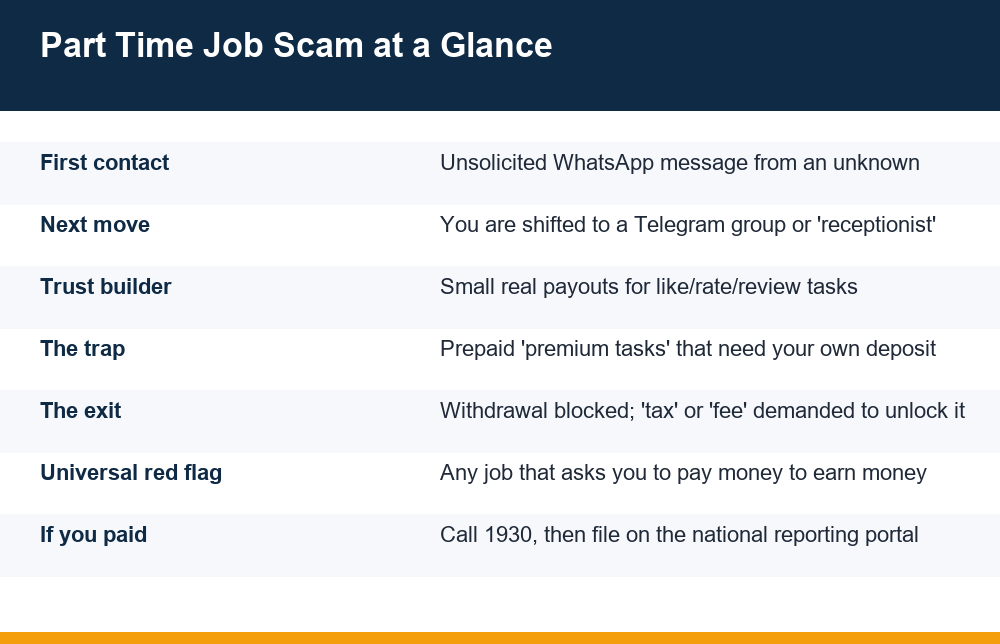
Before the lifecycle, the stages and the psychology, there is one rule that decides almost every case on its own: no genuine employer ever asks you to pay money in order to earn money. Not as a deposit, not as a registration fee, not as a ‘task activation’ amount, not as a tax or processing charge to release your earnings. Payment flows from employer to worker. The moment that direction reverses — in any form, under any label — you are looking at a part time job scam, and nothing else about the offer matters.
Everything else in this post is detail built around that rule. The scam script is designed to make the payment request feel reasonable by the time it arrives, which is why the request never comes first. It comes after days of small, real payouts, friendly chat and screenshots of other people’s ‘earnings’. If you remember only one thing, remember this: the ask to pay is not a step in the job. It is the job — the scammer’s job. Your deposit is the product.
This matters because the other signals can be faked well. Scammers now use real company names, cloned websites, professional-looking offer letters and HR-style language. The payment-direction rule cannot be faked, because collecting your money is the entire point of the operation. A fraudster can imitate everything about a real employer except the willingness to pay you without being paid first.
How a Part Time Job Scam Actually Unfolds
The lifecycle below is not one victim’s story. It is the common structure behind essentially every reported case of this fraud class, and understanding it as a sequence is what lets you exit early. Each stage has a specific psychological purpose, and each one hands the scammer a little more of your trust before the real extraction begins.
| Stage | What happens | What it is really for |
|---|---|---|
| 1. The ping | An unknown number messages you on WhatsApp offering easy part time work — liking videos, rating hotels, writing reviews | Mass-sent bait; replying marks you as a live, interested target |
| 2. The move | You are asked to join a Telegram group or contact a ‘receptionist’ for task allotment | Telegram hides the operator, allows fake group activity and is easy to abandon |
| 3. Paid trust | You complete tiny tasks and genuinely receive Rs 100–300 via UPI | Real money creates proof the job ‘works’ and lowers your guard |
| 4. The upgrade | You are offered ‘premium’ or ‘merchant’ tasks with bigger commissions — but these need a deposit from you | The actual extraction begins, disguised as an investment in your own earnings |
| 5. The squeeze | Your dashboard shows growing earnings; each withdrawal attempt triggers a new fee, tax or ‘wrong task’ penalty | Sunk-cost pressure: you keep paying to rescue money that never existed |
| 6. The cut | Once you stop paying, you are blocked and the group dissolves | The operation moves to the next batch of numbers |
Notice what the dashboard is doing in stages four and five. The ‘balance’ you watch grow is a number on a screen controlled entirely by the scammer. It is not an account, it is a story — and every fresh deposit you make is framed as the last step needed to turn the story into cash. It never is, because there is no cash on that side of the screen. There is only yours, already gone.
The same trust-then-extract structure shows up in fake earning platforms more broadly, which is why it helps to know how to tell a real online earning app from a fake one before any offer, solicited or not, reaches your phone.
Why Task Scams Pay Small Amounts First
The early payouts confuse people more than any other part of the scheme, and they are the reason victims defend the ‘job’ to worried family members right up to the end. Why would a fraudster send you money? Because it is the cheapest marketing spend available. A few hundred rupees buys something no advertisement can: your personal, first-hand experience of being paid. From that moment you are no longer evaluating a stranger’s claim — you are defending your own.
The small payments do three specific jobs at once:
- They create evidence. A real UPI credit in your own account is more convincing than any screenshot, and victims routinely show these credits to sceptical relatives as proof.
- They calibrate you. The scammer learns how quickly you respond, how eager you are, and roughly what deposit size you might absorb.
- They reframe the deposit. After receiving Rs 300, handing over Rs 5,000 for a ‘premium task set’ feels like scaling up a working system, not sending money to a stranger.
There is a related trick worth knowing: scammers often dress the early phase up as a referral or commission structure, borrowing the look of legitimate cashback and invite-a-friend programmes. Knowing how genuine referral earning apps in India actually structure their payouts — small, capped, and never requiring your own deposit — makes the counterfeit version much easier to spot.
The arithmetic is brutal and simple. The operation might pay out Rs 500 across a week of trust-building and collect Rs 50,000 or more in the deposit phase. Reported individual losses in this fraud class run from tens of thousands of rupees to tens of lakhs, and the early payouts are a rounding error against that return.
7 Red Flags, From First Message to Final Demand
Here are the seven signals, in roughly the order they appear in a live part time job scam. Any one of them should stop you; two or more are conclusive.
- The offer found you. You never applied anywhere, yet a recruiter has your number and a role ready. Legitimate hiring almost never begins with a cold WhatsApp message to a stranger.
- Pay is absurd for the work. Rs 3,000–8,000 a day for liking videos or rating hotels. Real micro-task work worldwide pays a tiny fraction of that, because the tasks have almost no value.
- The conversation moves to Telegram. A shift from the first channel into a Telegram group or private chat with a ‘receptionist’ or ‘mentor’ is a structural feature of the scam, not a quirk.
- No verifiable identity. No company domain email, no interview, no offer letter tied to a registered business you can independently look up — or a real company’s name used by someone with no provable connection to it.
- Group chats full of winners. Screenshots of payouts and celebratory messages from other ‘workers’ who are, in most cases, accounts run by the operation itself.
- Any request for a deposit. Registration fee, task activation, premium tier, security amount — the universal flag from the top of this post, in whatever costume it arrives.
- Withdrawal problems that cost money to fix. Taxes, penalties for a ‘wrongly completed task’, credit-score unlocks, conversion fees. Each one is the same demand wearing a new label, and paying one only summons the next.
Note how late flag six appears. By the time money is requested, flags one to five have usually all occurred and been explained away. That is the value of knowing the sequence: you can refuse at flag one and never meet the rest.
Telegram Groups and WhatsApp Offers: Questions Answered
Is any genuine job offered through random Telegram groups?
As a practical rule: no. Real employers and staffing agencies may use Telegram channels to broadcast openings they also publish elsewhere, but genuine recruitment — interviews, offers, onboarding, payment — does not happen inside an anonymous group you were added to by a stranger. A Telegram group with no verifiable company behind it, admin identities you cannot check, and members cheering their earnings is a stage set. Treat ‘join this group for task allotment’ as a red flag in itself, regardless of what the tasks are.
How do WhatsApp part time job offers reach my number?
Numbers are dialled in bulk by software or bought in bulk from leaked and scraped databases — app signups, delivery forms, breached marketing lists. Receiving the message does not mean you were researched or specially chosen; thousands of people got the identical text at the same moment. It also does not necessarily mean your phone is compromised. The right response is the boring one: do not reply (even to say no, which confirms the number is live), block the sender, and use the in-app report option so the platform can act on the account.
Does the scam only target people looking for work?
No, and this is part of why it spreads. Students, homemakers and salaried people with free evenings are all targeted, because the pitch is side income rather than employment. Anyone who would like an extra few thousand rupees a month — which is nearly everyone — is inside the target audience. Being employed, educated or financially careful offers no automatic protection; the script is built to work on ordinary, intelligent people in an optimistic moment.
A Verify-Before-You-Reply Checklist
Run this checklist before responding to any work-from-home or part time offer, whether it arrived by WhatsApp, Telegram, SMS, email or a job portal. It takes about fifteen minutes and costs nothing, which is exactly why fraudsters pressure you to decide in five.
- Find the company independently. Search the company name yourself and locate its official website. Do not use any link, number or email supplied in the message — verify through a route the sender does not control.
- Check the domain, not the design. A cloned site can look perfect. Check that the web address matches the real company exactly, and that any email comes from that domain rather than a free mail address.
- Search the name plus ‘scam’ and ‘fraud’. Recurring complaints with the same script — Telegram group, small tasks, deposit — are a conclusive answer.
- Demand a verifiable process. A real role has an interview, a named hiring contact you can call back through the company’s official number, and an offer letter referencing a registered entity.
- Apply the payment-direction rule. Ask directly: ‘Is any payment, deposit or fee ever required from me?’ Any yes, however it is justified, ends the conversation.
- Check the pay against reality. If the daily earnings exceed what skilled full-time work pays for unskilled ten-minute tasks, the money is bait, not salary.
- Sleep on it. Genuine openings survive a day of thought. Manufactured urgency — ‘only 3 slots left today’ — exists to stop you doing everything above.
None of these steps requires technical skill. The checklist works because a part time job scam is optimised for speed and emotion; every item on the list adds time and independent information, which are the two things the script cannot survive.
What to Do If You Already Paid
If money has already gone to a part time job scam, speed matters far more than embarrassment. Transferred funds move through mule accounts quickly, and the window in which a transaction can be flagged and frozen is short. Here is the order of operations:
- Stop all further payment immediately. No tax, no unlock fee, no ‘final step’. Every additional rupee is unrecoverable, and the demands will continue for exactly as long as you keep paying.
- Call 1930 as soon as possible. This is India’s national cyber crime helpline for financial fraud. Early reporting gives the system its best chance to freeze funds before they are layered onwards.
- File a written complaint online. Register the case on the National Cyber Crime Reporting Portal, which handles online financial fraud including job fraud. If you first reported by phone, complete the portal complaint promptly so the case has a full written record.
- Preserve everything. Do not delete the chats in anger. Screenshots of the WhatsApp messages, the Telegram group, the task dashboard, UPI transaction IDs, and the account or wallet details you paid into are the evidence the complaint runs on.
- Tell your bank or UPI app. Report the transactions as fraud through your bank’s or payment app’s official grievance channel so they are flagged at the account level too.
- Expect follow-up contact — from scammers. ‘Recovery agents’ who promise to get your money back for an advance fee are the same fraud in a second costume. Legitimate authorities never charge you to investigate.
Be realistic about outcomes: recovery is possible, especially with fast reporting, but it is never guaranteed, and losses in this fraud class are often permanent. That is a reason to report immediately, not a reason to stay silent. Every complaint also maps the mule accounts and numbers the operation depends on, which protects the next person in the queue.
Mistakes That Make Things Worse
A few common reactions to a part time job scam reliably deepen the damage, and they are worth naming because each one feels sensible in the moment.
Paying to withdraw. The single most expensive mistake. The displayed balance is fiction, so no fee can ever release it; people have lost many times their original deposit chasing it. Negotiating or threatening the scammer is equally pointless — the person in the chat has heard it all and loses nothing by blocking you — and it wastes the hours in which a 1930 call could have frozen the money.
Oversharing during ‘onboarding’ creates a second exposure beyond the money. A fake HR process may collect your full identity documents, bank details, card photos or OTPs under the cover of salary setup. That data feeds follow-on frauds, including attempts to take over your mobile number itself — the mechanics of SIM swap fraud show why a few ‘verification’ details can be worth more to criminals than your first deposit. Never share OTPs, card images or document photos with an employer you have not independently verified, and if you already have, tell your bank and telecom operator.
Staying silent is the quietest mistake. Shame keeps a large share of victims from ever filing a complaint, which suits the operators perfectly. Falling for a professionally engineered script is not stupidity — the same structure empties the accounts of engineers, teachers and retired bankers — and an unreported case is a free pass for the next round. Report it, warn your own contacts, and let the script die a little faster.
Frequently Asked Questions
How do WhatsApp part time job scams work?
They follow a fixed script: an unsolicited WhatsApp message offers easy paid tasks, you are moved to a Telegram group, small real payouts build trust, then ‘premium tasks’ require deposits from you. Your dashboard shows growing earnings, but withdrawals are blocked behind endless fees until you stop paying and are cut off.
Why do task scams pay small amounts at first?
The early payouts are the scam’s marketing budget. A few hundred rupees received in your own UPI account is proof the ‘job’ works, lowers your guard, and reframes the later deposit as scaling up a working system. The operation recovers that spend many times over in the deposit phase.
Is any genuine job offered through random Telegram groups?
Practically, no. Real recruitment — interviews, offer letters, salary — does not happen inside an anonymous Telegram group you were added to by a stranger. Groups full of payout screenshots and celebrating ‘workers’ are staged by the operation itself. Treat ‘join this group for tasks’ as a red flag on its own.
What should I do if I already paid money in a task scam?
Stop paying immediately, call the 1930 cyber crime helpline as fast as possible, and file a written complaint on the National Cyber Crime Reporting Portal at cybercrime.gov.in. Preserve all chats, screenshots and UPI transaction IDs, inform your bank or UPI app, and ignore ‘recovery agents’ who ask for advance fees — they are a second scam.
How can I verify if a work from home offer is genuine?
Find the company through your own search rather than any link in the message, check the exact web domain and email address, search the name alongside ‘scam’, insist on an interview and a named contact reachable via the company’s official number, and ask directly whether any payment is ever required from you. Any required payment means it is a part time job scam.
Who do I call to report an online job scam in India?
Call 1930, the national cyber crime helpline, especially if money has been transferred — early calls give the best chance of freezing funds. Then register a full complaint on the National Cyber Crime Reporting Portal (cybercrime.gov.in), keeping your transaction details and chat evidence ready.
