Earning Apps Without Investment: 7 Honest Realities Before You Start
You searched for earning apps without investment because you have a phone, some spare hours and nothing you can afford to lose — and nearly every page you opened promised ₹500 to ₹1,000 a day for taps and shares. This page is not another list of download links. It is a reality check, category by category: what referral apps, survey apps, micro-task platforms, academic Q&A sites and freelancing marketplaces actually pay per hour, and how some apps that start free quietly turn into paid ones. One honest line before anything else: where an app involves real-money play, it is for adults only, it carries risk, and losing is the expected outcome over time.
What ‘No Investment’ Really Means
No app runs for free. When an app pays you without taking your money, it is earning from something else you supply: your attention (ads watched), your data (survey answers, usage patterns), your network (people you refer) or your labour (tasks completed). That is not sinister by itself — it is simply the business model. The problem starts when the marketing hides the exchange rate. ‘Earn from home with zero investment’ is technically true for many apps, but the thing being invested is your time, and the hourly return is usually far below what the same hours would earn in almost any offline work.
Before going category by category, here are the seven realities the title promises. Everything else in this breakdown expands on one of them.
- ‘No investment’ means you pay with time, attention and data instead of money — and the hourly rate is usually low.
- Genuinely free apps never ask for money at any stage: not to join, not to unlock tasks, and never to withdraw.
- Advertised daily figures describe the best possible day for the most connected user, not a typical day for you.
- Referral income depends on an exhausting supply of new people and collapses once your circle is covered.
- Game-based earning apps have the highest fake rate of any category because their payout maths rarely works.
- Apps that start free often add fees later, because the economics of paying users to use an app are unsustainable.
- If you are ever asked to deposit money to release your own earnings, the earnings were never real.
Keep those seven in mind and most of the junk pages ranking for this search become easy to read for what they are: affiliate lists that earn a commission when you install, which is exactly why they have no incentive to tell you the real numbers.
Earning Apps Without Investment, Category by Category
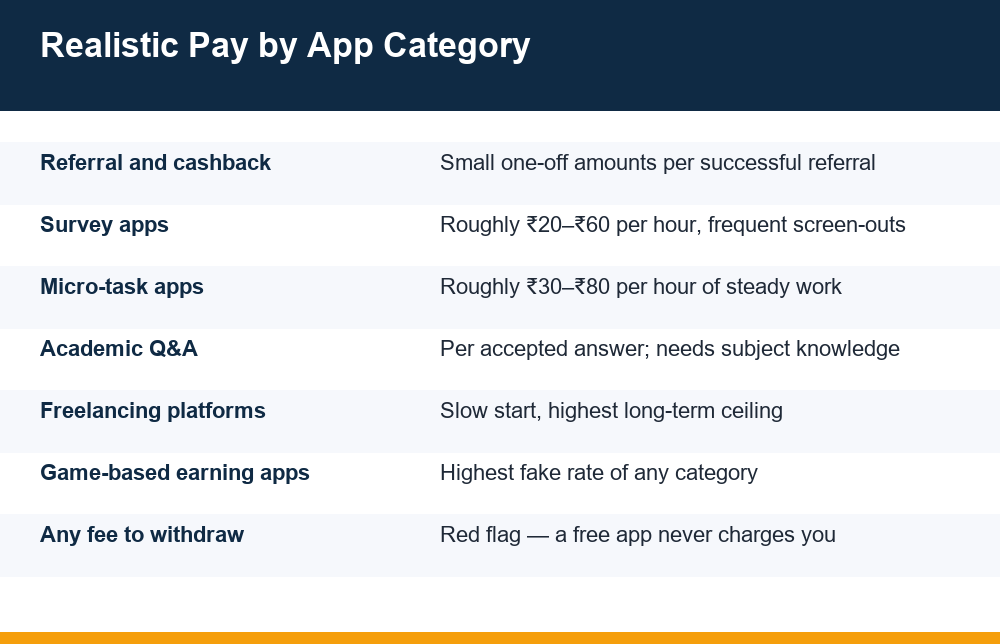
Genuine earning apps without investment fall into five broad categories, and each one pays through a different mechanism. The table below is deliberately conservative. These are typical ranges reported by ordinary users doing ordinary volumes of work — not the screenshot earnings of top referrers that promotional pages love to display.
| Category | What you actually do | Realistic return | Main catch |
|---|---|---|---|
| Referral and cashback | Share links, shop via tracked links | Small one-off amounts per action | Income stops when your contacts run out; cashback needs spending first |
| Survey apps | Answer consumer research questionnaires | Roughly ₹20–₹60 per hour | Frequent mid-survey screen-outs that pay nothing |
| Micro-tasks | Data labelling, app testing, short gigs | Roughly ₹30–₹80 per hour | Task supply is irregular; quality rejections unpaid |
| Academic Q&A | Answer subject questions for students | Per accepted answer | Needs real subject expertise; strict quality review |
| Freelancing | Writing, design, coding, voice work | Skill-dependent, grows over time | Weeks or months before the first paid order |
Two patterns are worth noticing. First, the categories that need no skill pay the least, because the supply of people who can tap a screen is effectively unlimited. Second, the only category whose ceiling rises over time is freelancing, because it is the only one where you accumulate something — a portfolio and reviews — rather than just hours.
Referral apps deserve their own caution
Refer-and-earn is the most advertised mechanism in this space and the most misunderstood. Payouts are real on legitimate platforms, but they are one-time amounts per person, your network is finite, and many apps void the bonus if the referred person does not complete a deposit or purchase. We have covered how referral earning apps structure their payouts and conditions in a separate breakdown — read the conditions section before you start sharing links in family groups, because burned referrals cannot be reused.
The Deposit-to-Withdraw Trap
This is the single most important section on this page, because it is the mechanism that converts ‘no investment’ into a loss. The pattern is remarkably consistent across fake earning apps, and once you can recognise it at step two, you will never reach step four.
- Step 1 — easy early wins. The app credits generous amounts fast: sign-up bonus, task bonus, spin rewards. Your in-app wallet grows to a few hundred or few thousand rupees within days.
- Step 2 — the locked withdrawal. When you try to cash out, a condition appears that was never prominent before: a minimum threshold just above your balance, a ‘verification fee’, a ‘processing charge’, a ‘tax deposit’ or a mandatory premium upgrade.
- Step 3 — the small payment. The amount asked is deliberately small relative to your wallet balance — pay ₹99 to release ₹2,000 feels rational. It is not. The ₹2,000 is a number in a database the operator controls; your ₹99 is real money.
- Step 4 — escalation or disappearance. Either a second fee appears (‘bank verification failed, pay again’), or the app stops responding, or your account is suspended for a fabricated violation.
The defining rule is simple: a legitimate free app never requires a payment from you to release money it owes you. Real platforms deduct any charge from the payout itself or absorb it. The moment money must flow from you to the app before money flows to you, treat the displayed balance as fiction and stop. If you have already paid and the app has gone silent, keep your screenshots, payment reference numbers and the app name, and report the incident on the Government of India’s cybercrime reporting portal at cybercrime.gov.in — reporting quickly gives the best chance that the receiving account can still be frozen.
If you want a fuller checklist for separating genuine platforms from staged ones, our breakdown of how to tell real earning apps from fake ones goes through the signals in order: payout proof quality, permission requests, support channels and withdrawal history.
Why Game-Based Apps Fail the Most
Of the five categories above, one was deliberately left out of the table: apps that promise payment for playing games. This category has the highest fake rate, and the reason is arithmetic, not bad luck. A survey app sells your answers to research firms — there is a buyer funding your payout. A micro-task app resells your labour to companies. But a ‘play games, earn cash’ app has only two possible funding sources: advertising revenue, or other players’ deposits.
Advertising pays app owners fractions of a rupee per view. An app genuinely funded by ads can afford to pay you a few rupees per hour at most — which is why legitimate ad-funded reward apps have painfully slow point systems. Any game app promising hundreds of rupees per day from ‘free play’ is describing payouts its ad income cannot possibly cover. That leaves the second model: your rewards are funded by deposits from players who came after you, or the balance is simply never paid at all.
A related sub-category dresses earning up as prize draws: spin wheels, scratch cards, lucky numbers and daily jackpots. These borrow the psychology of lottery products — near-misses, countdown timers, ‘one more spin’ — while rarely publishing any odds. We have examined how lottery-style apps present their draws and odds separately; the short version is that when the odds are not published, you should assume they are set entirely in the operator’s favour. No pattern of play changes that, because the margin is built into the structure itself. Treat any game-based app as entertainment with a cost, never as income, and if real money is involved, remember it is adult-only and losses are the expected outcome.
What Students Actually Earn Per Day
A large share of searches for earning apps without investment come from students, and the promotional pages targeting them are the most dishonest of all — ‘₹1,000 daily for students, no skills needed’ is a formula, not a report. Here is what the arithmetic actually supports for a student with two to three free hours a day.
On survey and micro-task apps, two focused hours typically produce ₹50 to ₹150 on a decent day, and some days produce nothing because no surveys match your profile or no tasks are available. Referral pushes can produce a one-off spike — a week where you earn a few hundred rupees — followed by nothing, because the people you know have all been referred. Academic Q&A platforms pay better per unit but accept only correct, well-formatted answers in subjects you genuinely know, and rejection rates for new contributors are high.
The honest monthly range for casual app-based earning is roughly ₹500 to ₹3,000 — pocket money, not income. That is not an argument against doing it; it is an argument for choosing where those hours go. A student who spends the same daily hours learning a billable skill — writing, spreadsheets, design tools, a programming language — earns almost nothing for the first months and then permanently out-earns every tap-for-cash app. The apps pay you today and nothing more; the skill pays you later and keeps paying. Treat app earnings as a side effect of idle time, never as a reason to allocate study hours to it.
Why Free Apps Add Fees Later
A recurring complaint pattern: an app that paid out smoothly for weeks suddenly introduces a withdrawal fee, raises its minimum payout from ₹100 to ₹1,000, or locks earnings behind a ‘premium membership’. Users feel cheated mid-stream, and they are — but the change is usually predictable from the app’s life cycle, and reading that cycle protects you.
Stage one is user acquisition: the operator spends money — bonuses, easy payouts, referral rewards — to inflate download numbers and ratings. Payouts in this stage are real and fast, which is where the glowing review screenshots come from. Stage two is the squeeze: growth money runs out, and the operator must extract revenue from the user base it bought. Thresholds rise, fees appear, tasks pay less, ads multiply. Stage three, for the worst operators, is the exit: withdrawals are delayed indefinitely, support stops answering, and the app disappears from the store with user balances unpaid.
The practical consequence is a single habit: withdraw early and withdraw often. Never let a balance accumulate inside any earning app, however smooth it has been. Cash out the moment you cross the minimum threshold, every time. A balance inside an app is a promise from a stranger; money in your own account is money. Users who treat the wallet as a savings pot are precisely the ones holding large balances when stage two or three arrives.
Checks Before You Install Anything
If you still intend to try earning apps without investment after the numbers above — and modest pocket money from idle time is a perfectly reasonable goal — run every candidate app through this checklist first. It takes ten minutes and filters out the majority of staged operations.
- Install only from the official app store. An ‘earning app’ distributed as an APK link in a message or video description bypasses every store review process — that alone is disqualifying.
- Read the one-star and two-star reviews first, sorted by recent. Search within reviews for the word ‘withdraw’. Payout complaints cluster there long before an app collapses.
- Find the withdrawal terms before earning anything: minimum amount, processing time, and any fee. If this information is hard to find, that is the answer.
- Check the permissions requested. A survey app has no business reading your contacts or SMS. Over-reaching permissions signal that your data, not your labour, is the product.
- Look for a real operator identity: a named company, a working support email, a privacy policy that names who collects the data. Anonymous operators cannot be held to anything.
- Start with the smallest possible test withdrawal before investing hours. An app that pays ₹50 promptly has passed a test; an app where you have 40 unpaid hours has leverage over you.
- Never pay to receive. Any deposit, fee, ‘verification’ charge or upgrade demanded before a payout means the balance is not real. Walk away regardless of the amount shown.
One final framing. The honest ceiling of this entire category is low, and that is precisely the information the ranking affiliate pages omit, because their income depends on your install, not your outcome. Used with the checklist above and the withdraw-early habit, earning apps without investment can convert genuinely idle time into small, real amounts. Expect anything more than that, and the app economy will take time or money from you rather than pay it.
Frequently Asked Questions
Which type of earning app needs no investment at all?
Survey apps, micro-task platforms, academic Q&A sites and skill-based freelancing marketplaces can be used with zero money down — you pay with time instead. The test of a genuinely free app is that no payment is ever required at any stage: not to register, not to unlock tasks, and never to withdraw your earnings. Referral and cashback apps are also free to join, though cashback only exists when you spend first.
Why does an app ask for money to withdraw my earnings?
Because the displayed balance is not real money — it is a number the operator controls, used as bait. The ‘verification fee’, ‘processing charge’ or ‘tax deposit’ is the actual product: a small real payment extracted against a large fictional balance. Legitimate platforms deduct any genuine charge from the payout itself. If an app demands a payment from you before releasing funds, stop, keep screenshots and payment references, and report it at cybercrime.gov.in.
How much can students really earn from apps daily?
With two to three free hours a day on surveys and micro-tasks, a realistic figure is ₹50 to ₹150 on a good day and zero on days with no matching tasks — roughly ₹500 to ₹3,000 a month. Advertised figures of ₹1,000 per day describe exceptional referral spikes or are simply fabricated. App earnings are pocket money from idle time; the same daily hours spent learning a billable skill out-earn every such app within a year.
Are survey apps worth the time they take?
Only as a use of otherwise dead time. Typical effective rates are ₹20 to ₹60 per hour once you account for screen-outs — surveys that eject you partway for not matching the target profile and pay nothing for the minutes spent. They are legitimate, low-risk and low-paying. Worth it while waiting for a bus; not worth displacing study, work or sleep.
Do refer and earn apps actually pay?
Legitimate ones do, but the income is structurally temporary: a one-time bonus per person, often conditional on the referred person completing a deposit, purchase or KYC step. Your network is finite, so earnings spike and then stop. Treat referral bonuses as occasional one-off amounts, be careful whose numbers you share, and read the bonus conditions first — an incomplete referral usually pays nothing.
Why do free earning apps suddenly add fees later?
It follows the app’s funding cycle. Early on, operators spend acquisition money on generous payouts to build downloads and ratings. When that money runs out, they must extract revenue from existing users: withdrawal fees appear, minimum payouts rise, and tasks pay less. The worst operators then delay withdrawals indefinitely and vanish. The protection is habitual: withdraw every balance as soon as it crosses the minimum, and never store earnings inside any app.
