
UPI Transaction Limit: 7 Essential Rules Worth Knowing First
A UPI transaction limit is one of those things everybody meets eventually, usually at the worst moment, and almost nobody understands in advance. The confusion comes from a single fact: there is no such thing as one limit. At least three apply simultaneously, set by different parties, and the one that stops your payment is whichever is lowest rather than whichever you have heard of. On top of that sit separate caps on how many payments you can make, special rules for the first day after adding a payee, and category ceilings that differ from the general one. These seven rules cover the whole picture.
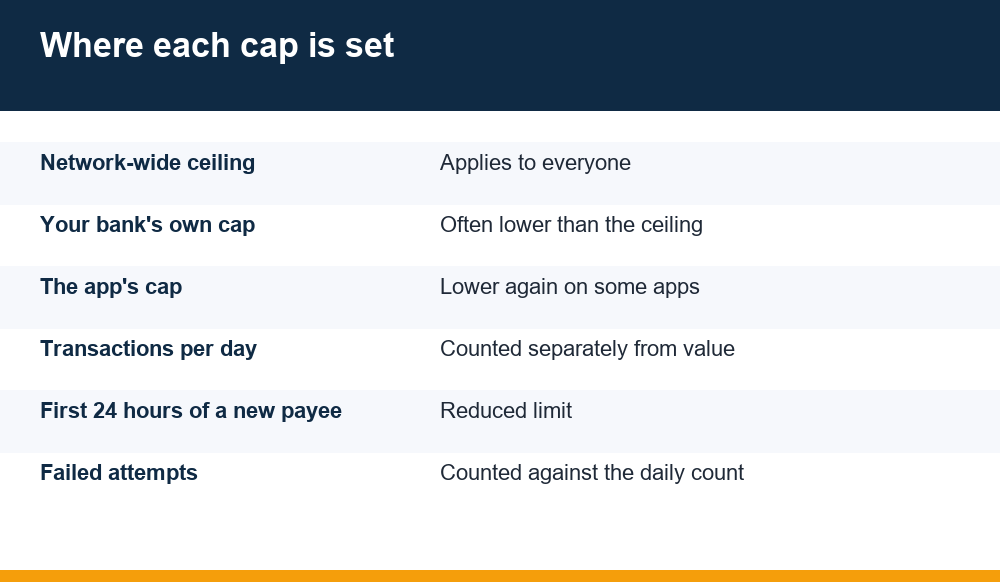
Rule one: your upi transaction limit is set in three places
The network sets a ceiling that applies to every user. Your bank sets its own, which is often lower. The app you are paying from sets another, which on some apps is lower again. Your effective UPI transaction limit is the smallest of the three.
This is why two people standing side by side, both using UPI, hit different walls. It is also why checking the headline figure published by the network tells you very little about what you personally can send.
How to find your actual number
Look in your banking app rather than the payment app, since the bank’s cap is usually the binding one. Many banks display it under UPI settings or transaction limits, and most will state it if asked. The payment app’s own limit is generally in its help section rather than its settings.
Rule two: the count matters as much as the value
Alongside a value cap there is a cap on the number of transactions in 24 hours, and it catches people who send many small amounts rather than a few large ones.
Someone splitting bills, paying several vendors or sending repeated small amounts can exhaust the count while nowhere near the value limit, and the error message rarely explains which limit was reached. The payment simply fails, often with a generic code.
The count also typically runs on a rolling 24-hour basis rather than resetting at midnight, which is why waiting until the next morning sometimes works and sometimes does not.
Rule three: new payees are capped for 24 hours
The first payment to a new recipient is usually restricted to a much smaller amount, with the normal limit applying only after a cooling period of around a day.
This is a deliberate anti-fraud measure and a good one. A great deal of payment fraud depends on moving a large sum to a newly added account within minutes of persuading somebody, and the delay removes that possibility.
It also explains a common and frustrating pattern: a payment that works perfectly on the second attempt a day later, with nothing having changed. Nothing did change except the clock.
- Add the payee and send a small test amount in advance where timing matters
- Expect the restriction on a genuinely new account, not merely a new app
- The limit lifts on its own; there is nothing to apply for
- Anybody urging you to bypass this is describing the attack it was built to stop
Rule four: some categories have their own ceilings
Certain payment types carry separate, higher or lower limits than ordinary person-to-person transfers, and the category is decided by how the recipient is registered rather than by what you think you are paying for.
Capital markets, insurance premiums, tax payments and some government collections have historically carried raised ceilings. Verified merchant payments can differ from personal transfers. None of this is visible at the point of payment, which is why an amount that fails to one recipient succeeds to another.
The practical consequence: if a payment of a given size fails, the amount is not necessarily the problem. The combination of amount and recipient category is.
Rule five: failed payments still count
This is the rule that produces the most confusion, and it is worth knowing before it happens rather than afterwards.
Declined attempts frequently count towards the daily transaction count, particularly when they were declined for an incorrect PIN. Three failed attempts followed by a successful one can consume four of the day’s allowance, and repeated PIN errors can trigger a temporary block on UPI entirely.
The sensible response to a failure is therefore to stop and check rather than to retry immediately. Retrying the same payment five times in a minute is the fastest route to being locked out for the rest of the day, and it rarely fixes whatever caused the first failure.
Rule six: raising a limit, and what cannot be raised
Where the binding constraint is your bank’s cap rather than the network ceiling, it can often be increased, usually through net banking or by asking the bank directly. Some banks allow it in the app; others require a branch visit or a written request.
What cannot be raised is the network-wide ceiling, and no legitimate route exists around it. This is worth stating plainly because it is a recurring theme in fraud: somebody offering to process a larger payment through an alternative channel, for a fee, is not solving a technical problem.
The new-payee restriction similarly cannot be waived on request. It expires on its own, and any instruction to work around it should be treated as the warning sign it is.
Rule seven: mandates sit outside the daily cap
Recurring payments set up through UPI autopay operate under their own rules and do not consume the ordinary daily allowance, which is convenient and occasionally surprising.
A mandate has a maximum amount agreed at setup and runs on a schedule until cancelled. Because it does not appear as a payment you actively make, it is easy to forget, and subscriptions set up years ago continue quietly debiting.
Reviewing active mandates is a five-minute job in any UPI app and routinely finds something unwanted. We covered the cancellation process, which is not always where people expect it, in our guide to cancelling a UPI autopay mandate.
What to do when a payment is declined
Work through these in order rather than retrying, since retrying is what causes the secondary problems.
- Check whether the recipient was added within the last 24 hours
- Count the day’s payments, including any that failed
- Try a smaller amount, which isolates a value cap from a count cap
- Check the bank app for a block or an alert rather than only the payment app
- If money left your account but did not arrive, do not resend
That final point matters. A debited-but-not-credited payment usually auto-reverses within a few days, and sending again produces two payments rather than one. If it has not reversed after the stated period, raise a complaint through the app, which generates a reference number the bank is obliged to work from.
Limits as a safety feature
Limits are experienced as an obstacle, and they are also the reason UPI fraud losses are usually bounded rather than total.
A compromised account with a daily cap loses the cap, not the balance. The new-payee restriction prevents a large transfer to an account added moments ago. The count limit slows an attacker trying many small transfers. Each is an inconvenience designed around a specific attack that was happening before it existed.
Which suggests a useful habit in the opposite direction from the usual one. Rather than raising your limit to the maximum available, consider lowering it to a little above what you actually need. Most people send far less than their cap permits, and the gap between the two is pure exposure with no benefit attached.
Where a larger payment is genuinely required occasionally, raising the limit for that transaction and lowering it afterwards takes a few minutes and leaves you protected the rest of the time.
Person-to-person versus merchant payments
One distinction sits underneath several of the rules above and is invisible at the point of payment: whether the recipient is registered as an individual or as a verified merchant.
The two are treated differently for limits, for dispute handling and for what happens when something goes wrong. A payment to a verified merchant carries a clearer route to a chargeback-style complaint. A payment to an individual’s handle is treated as a transfer between two people, and reversing it depends largely on the goodwill of the person who received it.
That difference matters far beyond the upi transaction limit it affects. If a business asks to be paid to a personal UPI handle rather than a merchant account, the convenience is theirs and the exposure is yours, and the usual explanation that the merchant account is temporarily unavailable deserves more suspicion than it typically gets.
Checking is simple: a verified merchant payment usually displays a registered business name at confirmation rather than an individual’s. Read that line before approving, because it is the clearest indication available of which set of rules will apply if the transaction is later disputed.
Keeping a record that is worth something
UPI generates a reference number for every transaction, successful or otherwise, and it is the single most useful thing to capture when something goes wrong. Complaints move quickly when they carry one and slowly when they do not.
The reference appears on the confirmation screen and in the transaction history inside the app. Screenshot it at the time rather than planning to retrieve it later, because histories are paginated, apps are reinstalled and the entry you want is the one you will struggle to find at the moment you need it.
For a debited-but-not-credited payment, that number plus the date and amount is effectively the whole complaint. Submit it through the app’s dispute route rather than only speaking to someone, since the written route creates a tracked case with a timeline attached, and the verbal route frequently does not.
Finally, check your statement monthly rather than relying on the app’s recent list. Small recurring debits from forgotten mandates are the most common thing people find, and they are visible in a statement in a way they are not in a feed of individual payments.
Frequently Asked Questions
Why does my payment fail when I am below the limit?
Because three limits apply at once: the network ceiling, your bank’s cap and the payment app’s cap, and the lowest one binds. There is also a separate cap on the number of transactions per day, which can be reached while the value total is still low.
Do failed payments count towards the daily limit?
Usually yes, particularly failures caused by an incorrect PIN. Repeated attempts can both exhaust the day’s count and trigger a temporary UPI block. When a payment fails, check the cause rather than retrying immediately.
Why is my first payment to a new person restricted?
New payees are capped at a lower amount for roughly 24 hours as an anti-fraud measure, since a large transfer to a freshly added account is a common fraud pattern. It lifts automatically and cannot be waived on request.
Can I increase my UPI limit?
Often yes, where your bank’s cap is the binding one, through net banking or by asking the bank. The network-wide ceiling cannot be raised by anyone, and offers to process larger payments through an alternative channel for a fee are a known fraud approach.
Does UPI autopay use my daily limit?
No, recurring mandates operate under separate rules and do not consume the ordinary daily allowance. That convenience is also why old subscriptions keep debiting unnoticed, so reviewing active mandates occasionally is worthwhile.
