Money Sent to Wrong UPI ID: 5 Smart Steps to Raise the Right Complaint Fast
Money sent to wrong UPI ID is one of the most panicked searches in Indian personal finance, and almost every page that ranks for it makes the same mistake: it opens with background framing and vague reassurance instead of telling you what to do in the next ten minutes. The order of your actions matters more than anything else here. Act in the wrong sequence and you burn hours on channels that cannot help yet; act in the right sequence and you give yourself the best realistic chance of getting the amount back.
This breakdown is a pure action list: who to contact first, exactly what details to quote, when to escalate, and the one warning that should sit at the top of every article on this topic but almost never does, because the follow-up scam often costs people more than the original mistake.
What Most Pages Get Wrong About Money Sent to Wrong UPI ID
The single biggest failure of the articles currently answering this question is burying the scam warning. When you have money sent to wrong UPI ID, you are at your most vulnerable in the hours that follow, and fraudsters know it. People post about the mistake on social media, call numbers they found through a search engine, or accept help from a stranger who “works in payments”. A follow-up scam at this stage can cost more than the original transfer did.
So here is the warning up front, before any step list: receiving money into your account never requires you to enter your UPI PIN, scan a QR code, or approve a collect request. Anyone who tells you otherwise, whatever they claim to represent, is trying to take a second payment from you.
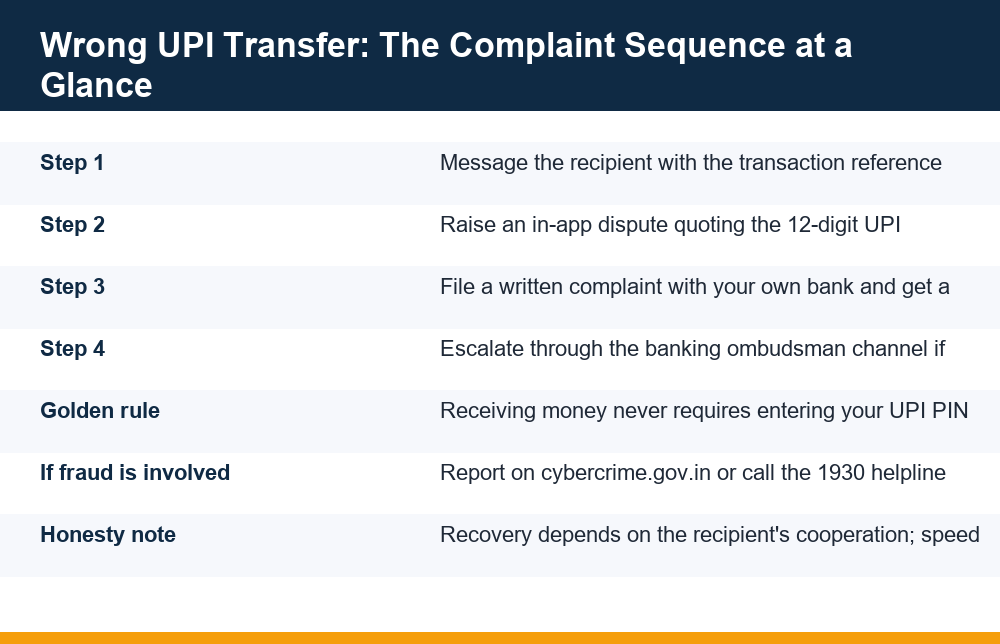
The second failure is sequence. Most pages list every possible remedy as if they were parallel options of equal weight. They are not. The channels form a ladder: the recipient first, the app second, your bank third, the ombudsman channel last. Each rung only makes sense after the one before it, because each later channel will ask what happened on the earlier one. Skip a rung and you will usually be sent back down to complete it.
The third failure is false comfort. Several widely shared explainers imply that a wrong transfer is routinely reversed if you complain quickly enough. The honest position is less soothing: a completed UPI transfer moves real money into a real person’s account, and getting it back generally requires either that person’s cooperation or a formal dispute process that takes time and does not always succeed. Knowing that from the start changes how seriously you treat the first two steps, which is where most successful recoveries actually happen.
First, Confirm What Actually Happened
Before raising any complaint about money sent to wrong UPI ID, spend two minutes confirming that your money genuinely landed in the wrong account. A surprising number of “wrong transfer” complaints turn out to be something else: a payment that failed mid-way, a delayed credit, or a transfer to the right person whose display name simply looked unfamiliar. Each of those has a different fix, and quoting the wrong problem to your bank slows everything down.
- Open the transaction in your UPI app and check its status: Success, Pending, or Failed. Only a successful transfer to an unintended ID is a wrong-transfer case.
- If the status shows failed or pending but your balance dropped, that is a different problem with its own process – see this breakdown of a failed UPI transaction where money was still debited.
- Note the exact UPI ID or number you paid. Compare it character by character with the one you intended. A single digit or letter is usually the culprit.
- Check the recipient name shown on the confirmation screen. UPI apps display the verified account-holder name before payment, and that same name appears in the transaction detail afterwards.
- Screenshot the transaction detail page showing the amount, date, time, recipient ID, and the 12-digit transaction reference (sometimes labelled UTR or UPI Ref No). Every later step will ask for these.
Once you have confirmed a successful transfer to the wrong ID and captured the reference details, start the ladder immediately. Time matters for one practical reason: money that is still sitting in the recipient’s account is far easier to return than money that has already been spent or moved on.
Step 1: Ask the Recipient Directly
The fastest recoveries are the ones that never become complaints at all. If the wrong UPI ID belongs to an ordinary person, a clear and polite request is genuinely your best tool. Most UPI apps let you message or initiate contact with a recent payee, and if the ID was a mobile number, you can simply call or send an SMS. Identify yourself, state the date, time, amount, and transaction reference, explain that the transfer was a mistake, and ask them to send the amount back to your UPI ID.
Keep the tone factual and courteous. The person on the other end did nothing wrong, may be worried the message itself is a scam, and is more likely to cooperate with someone calm than someone issuing threats. Give them the transaction reference so they can match it against their own statement, and offer to wait while they verify. If they agree, ask them to make a normal send transaction back to you – never a method that requires action on your side beyond sharing your UPI ID.
If the recipient does not respond within a day, or responds and refuses, do not keep pressuring them. Save the evidence of your attempt – screenshots of messages, call logs – and move to Step 2. Your contact attempt is not wasted: the dispute channels that follow will ask whether you tried to resolve it directly, and your record shows good faith. One caution worth repeating from the warning above: if the “recipient” suddenly becomes very helpful and starts walking you through screens in your UPI app, stop. Returning money to you requires nothing from your side.
Step 2: Raise the In-App Dispute With the Transaction ID
Every mainstream UPI app has a dispute or help flow attached to each transaction. Open the specific payment in your transaction history, choose the help or report option, and select the choice closest to “paid to the wrong person” or “payment made by mistake”. This registers a formal dispute against the exact transaction, which is far more effective than a generic email to customer support, because the dispute carries the transaction reference automatically and lands in the right queue.
Precision is what separates disputes that move from disputes that stall. Before you submit, have every detail from the table below in front of you. These are the fields app support teams and banks ask for in a case of money sent to wrong UPI ID, and supplying them in the first message saves a full round of back-and-forth.
| Detail | Where to find it | Why it matters |
|---|---|---|
| 12-digit transaction ID / UTR | Transaction detail page in your UPI app | The unique reference every system uses to trace the payment |
| Date and exact time | Transaction detail page | Distinguishes the payment from others to the same ID |
| Amount | Transaction detail page or bank statement | Confirms the disputed value precisely |
| Recipient UPI ID or number | Confirmation screen / transaction detail | Identifies where the money actually went |
| Intended recipient’s ID | Your own records | Shows the transfer was a genuine mistake |
| Your account and UPI ID | Your app profile | Where any returned amount should be credited |
| Screenshots of the transaction | Your phone gallery | Evidence that survives app updates and deleted histories |
After submitting, note the complaint or ticket number the app issues. Follow up through the same thread rather than opening duplicate tickets, which can reset the queue. The app’s support team can see which bank holds the recipient account and can route a return request, but they cannot pull money out of someone’s account without that person’s consent – which is why Step 1 came first and why Step 3 exists.
Steps 3 and 4: Bank Complaint, Then the Ombudsman Channel
If the in-app dispute does not produce a result within a reasonable window – a week is a sensible internal deadline to set yourself – escalate to your own bank, the one whose account funded the transfer. Visit a branch or use the bank’s official customer-care channel, and file a written complaint describing the wrong transfer. Quote the transaction reference, the app dispute ticket number, and the timeline of what you have done so far. Insist on a complaint reference number in return; a verbal “we will look into it” is not an escalation, it is a dead end.
Your bank can contact the recipient’s bank through inter-bank channels and request that the amount be returned. The recipient’s bank will typically seek the account holder’s consent before reversing anything, which again is why your evidence trail from Steps 1 and 2 matters: it documents that the transfer was a mistake and that you acted promptly. Keep copies of everything you submit and note the dates of every interaction.
If the bank’s response stalls or you receive a final answer you believe is wrong, the last rung is the banking ombudsman channel – a free, formal grievance route for unresolved complaints against banks and payment providers. It expects you to have complained to the bank first and waited for its response, which completes the logic of the ladder: each step generates the paper trail the next step requires. When you file there, attach the whole chain – transaction proof, app ticket, bank complaint reference, and the responses you received. A complete file is processed on its contents; an incomplete one generates requests for the documents you skipped.
One scenario deserves its own mention: if the recipient actively refuses to return the money despite acknowledging the mistaken credit, or if the “wrong ID” turns out to be an account used for fraud, the matter is no longer a simple transfer error. Report it through the National Cybercrime Reporting Portal or the 1930 helpline, and tell your bank you have done so. Fraud reports move through different, faster channels than ordinary transfer disputes, and early reporting improves the chance of freezing funds before they are moved on.
Step 5: Protect Yourself From the Fake Refund Trick
This step is not about recovering the first amount; it is about not losing a second one. The refund scam works because it arrives exactly when you are expecting a refund. Within hours or days of a wrong transfer – especially one you mentioned publicly or reported through an unofficial channel – you may get a call from someone claiming to be from your UPI app, your bank, or “the payments team”. They say your refund is approved and they just need to “process” it with your help.
What follows is always a variation of the same move: they send you a collect request to approve, ask you to scan a QR code, ask you to enter your UPI PIN “to receive the credit”, or direct you to install a screen-sharing app so they can “do it for you”. Every one of these actions sends money out of your account or hands over control of your phone. There is no version of UPI in which incoming money requires your PIN, your approval of a request, or a QR scan. Incoming money simply arrives.
- Never enter your UPI PIN to “receive” anything. The PIN authorises outgoing payments only.
- Never approve a collect or payment request from anyone promising a refund – approving it pays them.
- Never scan a QR code to get money. QR codes initiate payments from you, not to you.
- Never install screen-sharing or “support” apps at a caller’s direction; they can watch you type your PIN.
- Never share the OTPs that arrive on your phone during such a call – they can be used to take over your accounts, a technique closely related to SIM swap fraud and its warning signs.
- Hang up and call back through the official number printed on your card or inside your app, never a number the caller gives you.
Genuine refunds from a dispute arrive as ordinary credits to your account with no action needed from you, and genuine bank or app staff never ask for your PIN. The same social-engineering playbook – urgency, authority, a small action that “unlocks” money – runs through most payment frauds, including the part-time job scams that start with small task payments and end with victims paying “deposits” to withdraw their own earnings. Recognising the pattern once protects you everywhere it appears.
Realistic Timelines and Outcomes
Honest expectation-setting beats the vague optimism most coverage offers. A wrong UPI transfer is not reversed automatically. UPI is designed for instant, final settlement: once a transaction succeeds, the money sits in the recipient’s account, and no app or bank quietly claws it back on your say-so. Everything in the ladder above exists precisely because automatic reversal does not.
Timelines vary by channel. A cooperative recipient can return the money within minutes. An in-app dispute typically produces a first substantive response within a few working days. A bank-to-bank request takes longer because it involves two institutions and the recipient’s consent. The ombudsman channel is measured in weeks. None of these windows is fixed, so build your own record: note the date you raised each complaint and follow up politely at regular intervals, quoting your reference numbers each time.
On reporting speed: report a case of money sent to wrong UPI ID the same day if you possibly can, and within a few days at the outside. There is no generous grace period to rely on – apps and banks each apply their own dispute windows, and beyond the formal windows, the practical reality is that funds still sitting in the recipient’s account are recoverable in a way that spent funds are not. Every day of delay shifts the odds against you.
And the honest bottom line: some wrong transfers are never recovered, particularly when the recipient is uncooperative and the amount has been withdrawn. That is painful to read mid-crisis, but it is also the strongest argument for the prevention habits in the final section – and, for anyone who sends money in high-pressure contexts like real-money gaming or earning apps, a reminder that transfers made in haste are the ones that go wrong. If real-money play is part of your routine, remember that you must be 18 or over, that losses are the expected outcome over time, and that rushed payments are where mistakes like this one are born.
Mistakes That Sink Recovery Attempts
Beyond the refund scam, a handful of unforced errors reliably weaken wrong-transfer complaints. Most of them come from panic, and all of them are avoidable once named.
- Posting the mistake publicly with your details. Social posts tagging payment apps, showing screenshots with your number and transaction ID, are how scammers find and target you with the fake refund call.
- Searching for a customer-care number. Fake helpline numbers planted in search results and map listings are a known fraud route. Use only the help section inside your app or the number printed by your bank.
- Opening duplicate complaints everywhere at once. Multiple overlapping tickets fragment your case. One ticket per channel, escalated in order, with every reference number carried forward.
- Deleting or losing the transaction record. Clearing app data, changing phones, or uninstalling the app mid-dispute can cost you the evidence. Screenshot everything on day one.
- Accepting a stranger’s offer to “recover” the money for a fee. Recovery agents who contact you unprompted are running the second-loss scam in a different costume.
- Letting the complaint lapse. Disputes that receive no follow-up are quietly closed. Diarise a weekly follow-up until you have a final written answer.
- Not fixing the cause. After the dust settles, verify the recipient name on the confirmation screen before every future payment, send a token amount of one rupee first for new payees, and save verified contacts instead of retyping IDs.
Money sent to wrong UPI ID is a stressful, expensive lesson, but it is one lesson, not two. Follow the ladder in order, keep your reference numbers, refuse every request to act in your app “to receive money”, and you will have done everything that can realistically be done – while making sure the mistake stops at one transaction.
Frequently Asked Questions
Can I get my money back if I sent it to the wrong UPI ID?
Often yes, but it is not guaranteed. The fastest route is the recipient voluntarily returning it after a polite request with the transaction reference. Failing that, an in-app dispute, a written complaint to your bank, and finally the banking ombudsman channel form the escalation ladder. Recovery usually depends on the recipient’s cooperation or a formal process, so act the same day and keep every reference number.
Is wrong UPI transfer reversed automatically?
No. UPI settles instantly and finally, so a successful transfer places the money in the recipient’s account and no system reverses it on its own. Any return requires either the recipient sending it back or a dispute process involving the apps and banks concerned. This is why the first two steps – contacting the recipient and raising the in-app dispute – matter so much.
How do I raise a complaint for a wrong UPI payment in my app?
Open the exact transaction in your app’s history, choose the help or report option attached to it, and select the choice closest to ‘paid to the wrong person’. Quote the 12-digit transaction ID, date, time, amount, and the recipient ID, and save the ticket number you receive. Raising the dispute from the transaction itself routes it correctly; a generic support email does not.
What happens if the wrong recipient refuses to return the money?
Save the evidence of your request and their refusal, then escalate: file a written complaint with your bank quoting the transaction reference and your app ticket, and if that stalls, take the file to the banking ombudsman channel. If the refusal suggests the account is being used for fraud, report it on the National Cybercrime Reporting Portal at cybercrime.gov.in or call 1930.
How many days do I have to report a wrong UPI transfer?
Report it the same day if possible, and within a few days at most. Apps and banks each apply their own dispute windows, and more importantly, money still sitting in the recipient’s account is far easier to return than money already withdrawn or spent. Every day of delay reduces the practical chance of recovery, whatever any formal window allows.
Do I need to enter my UPI PIN to receive a refund?
Never. The UPI PIN authorises payments going out of your account, and incoming money arrives with no action from you. Anyone asking you to enter your PIN, approve a collect request, or scan a QR code ‘to receive your refund’ is running the fake refund scam and will take a second payment from your account. Hang up and report the number.
