Online Earning Apps Real or Fake: 9 Essential Checks Before You Sign Up
Online earning apps real or fake is a question you can settle yourself, in about fifteen minutes, without reading a single review of the specific app. Most pages that promise an answer either promote the app they are reviewing or repeat “if it sounds too good to be true, it probably is” — which is true but useless the moment a convincing app appears. This breakdown gives you something better: nine checks that work on any earning app, today or three years from now, because they test the mechanics every fake app depends on rather than the name on the icon. Run them in order and the app will usually disqualify itself before check five.
The Short Answer Before the Detail
Here is the short answer. A genuine earning app pays you for something that has real value to someone — your time watching ads, your opinions in surveys, your labour doing micro-tasks, your data. Because that value is small, genuine apps pay small amounts, slowly, and never ask for money up front. A fake earning app inverts every one of those properties: it promises large amounts, quickly, and sooner or later asks you to pay — a joining fee, a deposit, an “upgrade”, a “tax” on your withdrawal.
That single inversion is the spine of the whole question of online earning apps real or fake. Every check below is just a different way of catching it early, before you have handed over money, hours of your time, or the contents of your phone. Some checks catch outright scams. Others catch the greyer category: apps that do pay at first, then quietly stop — which, as covered later, is not an accident but a business model.
One honest note before the checklist: even the genuine apps pay very little. If an app is your plan for meaningful income, the maths section near the end matters more than any scam check.
Online Earning Apps Real or Fake: All 9 Checks at a Glance
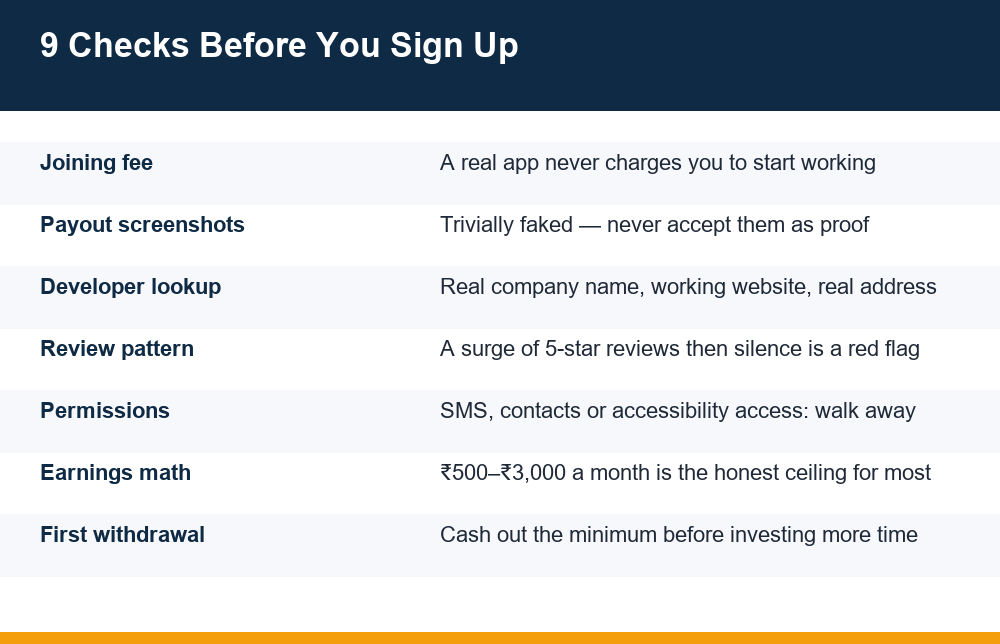
Each check takes one to three minutes and needs nothing more than the app’s store listing, a search engine, and your phone’s settings. The table shows what each check tests and what a failure means. A single hard failure — a joining fee, a dangerous permission, an anonymous developer — is enough to stop. You do not need the app to fail all nine.
| # | Check | What a failure means |
|---|---|---|
| 1 | Joining fee test | You are the product being sold money, not a worker being paid |
| 2 | Payout-proof skepticism | The app’s “evidence” is manufactured marketing |
| 3 | Withdrawal threshold maths | The payout bar is set where most users give up |
| 4 | Developer and company lookup | Nobody accountable exists behind the app |
| 5 | Review-pattern reading | Ratings were bought in a burst, not earned over time |
| 6 | App age and update history | The app is built to be abandoned, not maintained |
| 7 | Permission audit | The real target is your data or your messages |
| 8 | Source-of-money test | Earnings come from new users’ deposits, not real work |
| 9 | First-withdrawal exit test | The app talks about paying but never actually pays |
The order is deliberate: the first three checks need no installation at all, so you can disqualify most fakes without the app ever touching your phone.
Checks 1–3: Follow the Money
Check 1 — the joining fee test
No legitimate employer charges you for the right to work, and no legitimate earning app does either. The joining fee exists because it is the business: collect ₹99 to ₹999 from thousands of sign-ups, pay a few early users a fraction of it so word spreads, keep the rest, vanish, relaunch under a new name. The fee is often dressed up as “registration”, “KYC processing”, “premium activation” or a “refundable security deposit” that is somehow never refundable. The dressing changes; the test does not. If any money must leave your account before money can enter it, close the app. This is the one check with no exceptions.
Check 2 — payout-proof skepticism
Screenshots of UPI credits, wallet balances and “today’s withdrawals” are the universal decoration of fake earning apps, and every one of them can be produced in under a minute. Screenshot-editing tools, fake-payment-screen generator apps, and simple image editors all exist precisely for this. Even genuine-looking notification screenshots prove nothing, because you cannot verify the sender, the account, or whether the transaction was simply a scammer paying themselves. Treat every payment screenshot — in the app, on a Telegram or WhatsApp group, in a video — as marketing, not evidence. The only payout proof that counts is money arriving in your account, which is what check 9 is for.
Check 3 — withdrawal threshold maths
Open the app’s listing or FAQ and find two numbers: what a task pays and the minimum withdrawal amount. Then do the division. If tasks pay ₹0.10 and the minimum withdrawal is ₹5,000, the app is designed so that almost nobody ever reaches a payout — your ad views and referrals generate revenue for the operator the whole way there. A genuine app keeps the first withdrawal low and reachable within days, because paying you is how it keeps you. A threshold that sits weeks or months of effort away is not a payment policy; it is a trap door.
Checks 4–6: Who Is Behind the App
Check 4 — developer and company lookup
On the store listing, scroll to the developer section and read it the way a lender would read a loan application. A genuine operation shows a company name, a working website with the same branding as the app, a privacy policy hosted on its own domain, and a contact address. Fakes show a free-mail contact address, a privacy policy pasted on a free blogging site, no website at all, or a developer account whose other apps are a random grab-bag of wallpapers and flashlight tools. Search the company name plus words like “complaint” or “withdrawal problem” and see what surfaces. Two minutes here filters out most of what the first three checks missed.
Check 5 — reading the review pattern
The star rating is the least useful number on the listing; the shape of the reviews over time is the most useful. Sort reviews by newest and look for a specific signature: a dense surge of short five-star reviews in generic English (“best app”, “genuine app fast payment”) clustered within a few weeks, followed by a wave of one-star reviews that all tell the same story — withdrawal pending, account blocked at payout, minimum raised overnight. That surge-then-silence pattern means the early ratings were purchased and the later ones are real users hitting the wall. Also discount reviews that mention earnings but no specifics, and give extra weight to detailed one-star reviews that name amounts and dates.
Check 6 — app age and update history
Fake earning apps live fast. They launch, farm sign-ups and fees for a few months, and are removed or abandoned before accountability catches up. The listing usually shows a release date and a last-updated date: an app that is weeks old with hundreds of thousands of installs and a perfect rating has bought its way there. Age alone proves nothing — new genuine apps exist — but combined with check 5 it is close to conclusive. An app that has paid users steadily for two or more years has survivable economics; an app that has existed for two months has not yet proved anything, and you should weight every other check more harshly.
Checks 7–9: Your Phone, Your Data, Your Time
Check 7 — the permission audit
An app that pays you for watching ads or filling surveys needs an internet connection and, at most, storage access and notifications. Anything beyond that deserves suspicion, and some permissions are outright disqualifying because they are the toolkit of financial fraud rather than of task work. An earning app should never need:
- SMS access — reading your messages means reading your bank alerts and one-time passcodes
- Contacts — your address book becomes the scam’s next marketing list
- Accessibility services — this grants the ability to see and operate your entire screen, including payment apps
- Call logs or phone access — irrelevant to any earning task that exists
- Device admin rights — can make the app difficult to uninstall
- Installation from outside the official store via an APK link — not a permission, but the single biggest warning sign of all, because it bypasses every store review
Check permissions before installing, from the listing’s data-safety section, and again after installing in your phone’s settings — apps can request more later. If an earning app asks for anything in the list above, the earnings were never the point; your data was.
Check 8 — the source-of-money test
Ask one question: who is actually paying for my earnings? If the answer is advertisers, survey buyers or task clients, the economics can be real — small, but real. If the answer is “new members”, the app is a recycling machine for deposits and will behave exactly as described in the next section. If you cannot work out any answer at all — the app just “gives coins” for taps, spins or daily logins with no visible advertiser — assume the revenue is your attention and data, and the payout is theatre.
Check 9 — the first-withdrawal exit test
If an app has passed the first eight checks and you decide to try it, set a rule before you start: reach the minimum withdrawal once, cash out, and invest nothing more — no time, no referrals, certainly no money — until that payment lands in your account. A genuine app clears this test unremarkably. A fake one reveals itself precisely here, with a “processing” state that never ends, a sudden verification fee, or an account suspension at the moment of payout. The test costs you a few days of light use and settles the question with the only evidence that counts.
Why Earning Apps Stop Paying After Some Days
The most common story in one-star reviews is not “it never paid” but “it paid, then stopped” — and understanding why protects you from the most convincing category of fake. Many of these apps run on a simple circulating-money mechanic: early users are paid quickly and visibly, using money collected from joining fees, deposits or the operator’s own seed fund. Those early payouts are not a cost to the operator; they are its advertising budget. Paid users post real payment screenshots, recruit friends and relatives through referral bonuses, and give the app the one thing fake proof cannot buy — genuine word of mouth.
The arithmetic has a fixed ending. Payouts grow with the user base, while income depends on ever more new joiners, so the moment growth slows the operator faces a choice between paying out the remaining pool or keeping it. They keep it. Withdrawals move to “pending”, the minimum threshold quietly rises, a new “verification” step appears, and then the app stops opening at all. None of this is a malfunction; it is the scheduled final phase. The same circulation logic drives many part time job scams that run on WhatsApp and Telegram, where small “task payments” arrive on day one to set up a large “prepaid task” loss on day ten.
The practical consequence: an app having paid you yesterday is weak evidence it will pay you tomorrow. That is exactly why check 9 caps your exposure — withdraw early, withdraw often, and treat any balance left inside the app as money you may never see.
What You Can Realistically Earn
The last filter for deciding whether online earning apps real or fake claims hold up is plain arithmetic, because fake apps are usually exposed by their own numbers. Advertisers pay fractions of a rupee for an ad view. Survey buyers pay a few rupees for a completed response, and most users are screened out of most surveys. Micro-tasks pay per piece at rates that reflect the fact that thousands of people compete for them. Stack it all up honestly and the realistic band for casual daily use of genuine apps is roughly ₹500 to ₹3,000 a month — pocket recharge money, not income. Anyone very systematic across several apps might push somewhat past that; nobody gets to a salary.
That band is the benchmark. An app advertising ₹1,000 a day for watching videos is claiming to pay you hundreds of times what your attention is worth on the open market, and nobody runs a business by overpaying strangers at that scale. The gap between the promise and the band is not optimism; it is the measure of the lie. A breakdown of earning apps that work without any investment shows the same pattern from the other side — the ones that are real are real precisely because their numbers are small.
It is also worth separating task-based earning apps from real-money gaming apps, which some listings blur together. Task apps pay for work; gaming apps pay winners out of losers’ entry fees minus the platform’s cut, which means the average user loses by design — that is margin, not malfunction. Real-money play is for adults only, carries genuine financial risk, and losing is the expected outcome over time. A wider look at how the earning-app landscape is shaping up in 2026 covers how these categories differ and why the distinction matters more than any single app’s marketing.
What to Do if You Already Paid
If an app has taken a joining fee, swallowed a balance you earned, or extracted a deposit, act in order of urgency:
- Cut the app’s access first. Revoke its permissions in your phone settings, then uninstall it. If it had SMS or accessibility access, change the passcodes and PINs of your UPI and banking apps from a device the app never touched, or after removal.
- Preserve evidence before it disappears. Screenshot the app listing, your transaction records, chat messages, the in-app balance and any withdrawal-pending screens. Note transaction IDs (UTR numbers), dates and amounts.
- Report the fraud quickly. File a complaint on the National Cyber Crime Reporting Portal or call the 1930 cyber fraud helpline — speed matters, because a fast report gives banks a chance to freeze the money in transit.
- Tell your bank or UPI app support about the transaction through its official in-app support channel, quoting the same transaction IDs.
- Warn the people you referred. If the app paid you referral bonuses, people you brought in are now exposed; telling them early is the one part of the damage you can undo.
- Leave an accurate store review with amounts and dates. Detailed one-star reviews are exactly what check 5 relies on — yours becomes part of the next person’s answer.
Do not pay any “recovery agent” who contacts you promising to get the money back for a fee; recovery fraud is the standard second act of the same scam, run against the same victim list.
The nine checks are deliberately boring, and that is their strength. Fake apps change names, icons and stories every few months, but they cannot change the mechanics these checks test — they must ask for money, hide their operators, inflate their reviews, overreach on permissions and promise impossible rates, because that is what being fake consists of. Run the checklist on the next app that promises easy money, and the question of online earning apps real or fake stops being a matter of opinion and becomes a fifteen-minute procedure.
Frequently Asked Questions
How can I check if an earning app is genuine?
Run nine quick checks: no joining fee, ignore payout screenshots, confirm the withdrawal minimum is reachable within days, look up the developer’s company and website, read the review pattern over time, check the app’s age, audit its permissions, work out who actually funds the earnings, and test one small withdrawal before investing any more time. A single hard failure — a fee, a dangerous permission, an anonymous developer — is reason enough to stop.
Why do earning apps ask for a joining fee?
Because the fee is the business. Collecting ₹99–₹999 from thousands of sign-ups, paying a small share back to early users for word of mouth, and keeping the rest is the entire revenue model of most fake earning apps. No legitimate app or employer charges you for the right to work, so any upfront payment — however it is labelled, including ‘refundable deposits’ and ‘KYC charges’ — is a disqualifying sign.
Are payment proof screenshots on earning apps real?
Treat them all as marketing. Payment screenshots are trivial to fabricate with image editors and fake-payment-screen generators, and even real ones can show a scammer paying themselves. You cannot verify the sender, account or context of any screenshot. The only payout proof that matters is money arriving in your own account from a small test withdrawal.
Which permissions should an earning app never need?
SMS access (it can read bank alerts and one-time passcodes), contacts (your address book becomes the scam’s next target list), accessibility services (full control over your screen, including payment apps), call logs, and device admin rights. An app that pays for ads or surveys needs little more than internet access. Installation via an APK link outside the official store is an even stronger warning sign.
Why do earning apps stop paying after some days?
Many run on circulating money: early users are paid from joining fees and deposits so they post real proof and recruit others. Payouts grow with the user base while income depends on new joiners, so when growth slows the operator freezes withdrawals, raises thresholds or adds fake ‘verification’ fees, then disappears. The early payments were advertising, not evidence — which is why past payment is weak proof of future payment.
How much can you realistically earn from money earning apps?
For casual daily use of genuine task, survey and ad-reward apps, roughly ₹500 to ₹3,000 a month — recharge money, not income. Ad views pay fractions of a rupee and surveys a few rupees each, with heavy screening. Any app promising hundreds or thousands of rupees per day is claiming to pay far more than your attention is worth to any advertiser, which is itself the clearest sign it is fake.
